
Jacksonville financial leaders forecast slower but steady expansion as interest rates ease (Courtesy of the Jacksonville Business Journal) — In 2026, Northeast Florida’s financial leaders aren’t betting on another record-breaking year, but they see plenty of room for growth.
From Jacksonville’s logistics corridor to its quiet rural tracts eyed for data centers, the region’s financial leaders see opportunity as interest rates ease and technology redefines the economy. Equally, they also see a need for adaptability.
Executives from Wells Fargo, Fifth Third and J.P. Morgan forecast three forces shaping 2026: the rapid integration of artificial intelligence and the infrastructure it demands; a push for supply chain resilience; and strategies to guard against inflation.
For Northeast Florida, that means financing everything from multi-million-dollar equipment upgrades to capital-intensive data center projects, all while keeping the foot on the gas in a market that remains one of the nation’s fastest-growing.
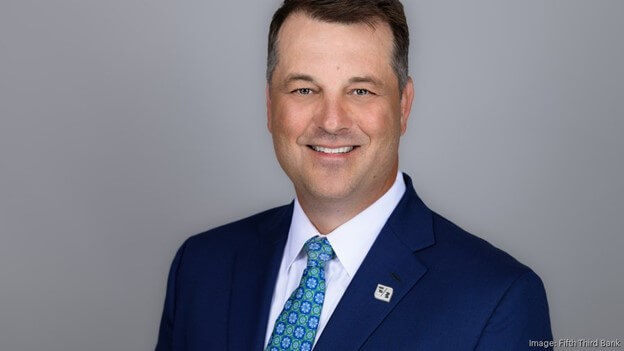
“It’s tough to think that coming off as hot a year as we’ve had in 2025 that it will be as hot,” said Scott Daigle, Fifth Third’s North Florida regional president (pictured above). “There’ll be some sort of settling in.”
After a year that saw a country-wide push on near-shoring manufacturing, Daigle sees Northeast Florida’s strength not in heavy manufacturing but logistics and distribution. The region, and Florida at-large, is more of a final stage assembly market, he said, pointing to Jacksonville’s ports and railroad infrastructure as key advantages.
Those strengths, he said, will continue to attract capital in transportation, warehousing and logistics operations.
At the same time, the Fifth Third leader noted that merger activity in manufacturing may remain muted compared to other sectors. Instead, he expects organic growth and incremental investment to define the year ahead, with banks playing a key role in financing equipment upgrades and working capital for companies adapting to shifting trade policies.
That premise rang true for Wells Fargo in 2025. Locally, the national bank has leaned into its role as more than a lender for Jacksonville’s business community — positioning itself as a strategic partner for the region’s logistics backbone.
“There’s this saying: ‘Stability is the new luxury,’” said Nick DiPierro, Wells’ market executive and commercial banking leader for North Central Florida. “A lot of companies now have figured out a way to be adaptable throughout environments and, after tariffs, we’re now past peak uncertainty.”
As it pivots into 2026, Wells Fargo is thinking about supporting the Jacksonville-wide push for revitalization. But beyond the downtown core, local financial leaders are also thinking about the shifting world of artificial intelligence.
J.P. Morgan’s 2026 outlook showed that as AI adoption accelerates, attention is shifting to the physical backbone needed to power it — assets like data centers, energy infrastructure and logistics networks.
Analysts tell the Business Journal that these investments not only underpin the AI economy but also offer a buffer against inflation and market volatility, a combination increasingly relevant for Jacksonville’s growing base of tech-curious companies and high-net-worth investors.
“There’s a lot of optimism about Jacksonville’s potential as a hub for data centers and AI technology companies,” said Matthew Marcin, executive director and market team lead at J.P. Morgan Private Bank in Jacksonville. “The regional momentum is strong.”
Growth in popularity during 2025 has fueled the private bank’s local focus toward such investments, particularly the energy fueling AI. Across the board, J.P. Morgan believes that investment could help stave off inflation impacts.
Even as the Federal Reserve continues its gradual rate-cutting cycle, bankers consulted by the Business Journal expect it to remain a factor in the year ahead.
“We do think that there’s going to be slightly higher than kind of long-term trend inflation going into next year, but nothing overly elevated,” said Marcin, adding that the Fed is “trying to balance two different things, one being the labor market with keeping a lid on inflation.”
For investors, the message is clear: opportunity in 2026 will favor strategy over speed.
Bankers are steering clients toward sectors that combine stability with upside — real estate, healthcare, logistics and the expanding AI ecosystem — while keeping a close eye on inflation and global risk.
From AI-driven infrastructure to resilient supply chains and inflation-proof investments, the region’s bankers are positioning for a market that rewards adaptability — and they expect Jacksonville to remain a magnet for capital and talent.