
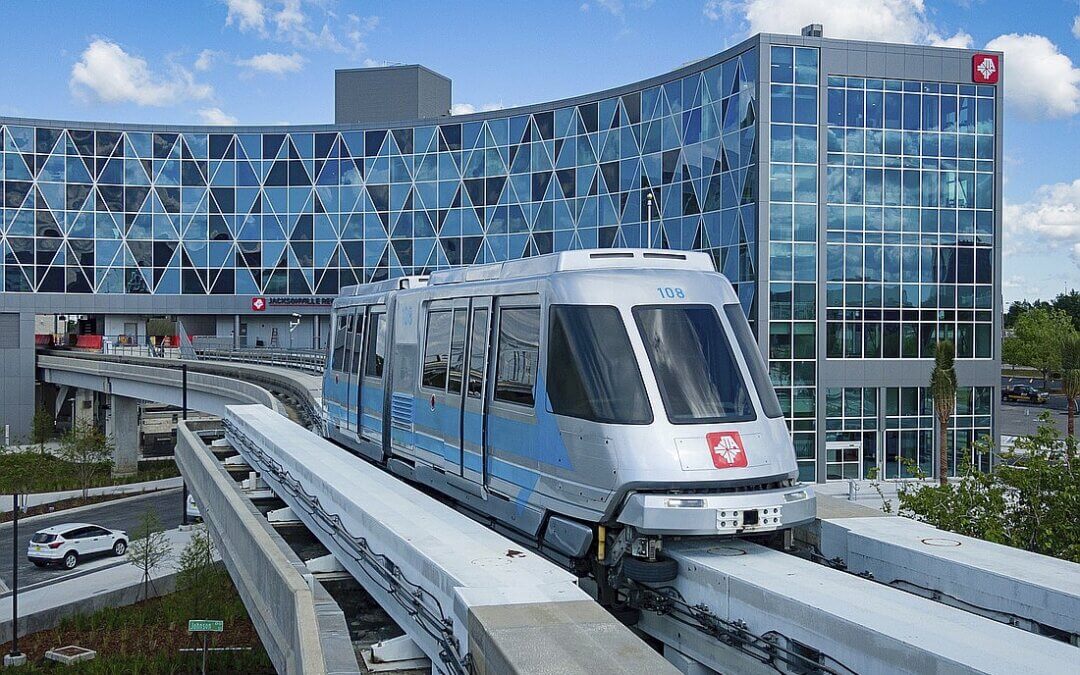
JTA reducing more services, laying off employees to address further budget concerns (Courtesy of the Jacksonville Daily Record) — The Jacksonville Transportation Authority will lay off up to 194 employees, suspend some public transportation Downtown and reduce service along a portion of bus routes to deal with a $39 million budget deficit, the authority announced Sept. 17.
Cleveland Ferguson, who was appointed interim CEO in August, said the actions were necessary to help JTA contend with financial uncertainty and protect the future of the authority. The layoffs and service cuts follow a report by City Council auditors attributing JTA’s budget problems to such factors as over-budget spending, declines in year-over-year revenue from sales and gas taxes and losses from a fare reduction pilot program.
“(The decisions were made) at the board’s direction to go forward and to do what is necessary to get us back on solid ground,” Ferguson said. “We are going to make the tough decisions now, protect our core mission and stabilize today to restore tomorrow.”
JTA said it would lay off up to 44 administrative staff and 150 operations personnel of its 846 employees. That would amount to more than one-fifth of JTA’s total workforce.
In addition, the authority said it will suspend service on the Downtown Skyway tram beginning Nov. 2, a move designed to save $10 million. JTA also plans to save $5.84 million by suspending Downtown Neighborhood Autonomous Vehicle Innovation service beginning Jan. 1.
The authority will reduce service on many of its bus routes to Saturday levels in coming weeks.
JTA said the suspension of Skyway and NAVI service would be indefinite. It did not say what it would save from the layoffs and frequency reductions.
An August report by City Council auditors said JTA was expected to finish its current fiscal year with a $31.8 million deficit. That was an increase from the projected $2.25 million deficit reported six months into JTA’s fiscal year, which runs from Oct. 1 to Sept. 30.
JTA’s original budget for fiscal year 2025-26 totaled $185.36 million.
Ferguson said Sept. 17 that JTA was projecting this year’s deficit at $39 million.
Deegan, Council react
City and JTA leaders said a possible long-term solution involves diverting funding for the authority’s autonomous Ultimate Urban Circulator system.
In 2021, Council approved a 6-cent Local Option Gas Tax designed to provide $247 million to help develop the U2C, as the system is also known. The U2C funding, a portion of the nearly $1 billion generated by the LOGT, comes through an interlocal agreement between JTA and the city.
JTA and Council members said they would discuss amending that agreement to use the U2C funding for other priorities.
Council President Nick Howland told the Daily Record that he would instruct the Council’s Financial Audit and Oversight Committee to review JTA projects funded by the LOGT “in order to stabilize the authority and optimize spending on the transportation initiatives that matter most to the people of Jacksonville.”
In a statement, Mayor Donna Deegan’s administration said it would work with departing JTA employees to find employment opportunities with the city, other independent agencies and city partners.
“JTA’s board was not previously aware of the dire nature of the agency’s financial situation,” spokesperson Phil Perry wrote. “We became aware as they did. As we all move forward, there must be a collective effort to learn from the past with an eye toward ensuring world class public transit in the future.”
“JTA must focus on improving its financial situation and the services that customers rely on every day. If these objectives require local option gas tax funding, any interlocal agreement changes must be negotiated with the administration — and Emerald Trail funding must be protected,” Perry wrote.
The LOGT also funds the development of the Emerald Trail, a 30-mile route in central Jacksonville connecting 14 neighborhoods to Downtown, the St. Johns River, McCoys Creek and Hogans Creek. Along the route are 16 schools, two colleges and 21 parks.
Council member Rory Diamond, the Council’s liaison to the JTA, commended Ferguson for “doing what needed to be done” on what he called “a tough day for JTA and their employees.”
“Once the ship is righted, there are some tough questions to be asked as to how things (got) so far,” he said.
Council member Jimmy Peluso, whose District 7 includes the Downtown Northbank, said the situation presented an opportunity to reevaluate the JTA’s priorities.
“It’s shame we had to get here, but I’m glad we are taking a serious look at JTA and their projects,” he said in a prepared statement. “We should want JTA to provide efficient and fast transit in the largest City in the US.”
“If that means we need to cut the NAVI and go back to basics, I think it would be well received by its users. I also believe light rail and other mass transit options need to be considered as the future of this City, and once we right the ship, I’d like to us have a frank and constructive conversation about it.”
The Council auditors reported that JTA’s deficit came from $17.4 million in revenue shortfalls, $10.5 million of which came from lower-than-projected revenues from sales and gas taxes.
Passenger fare revenues also fell $1.8 million, which auditors attributed to the six-month fare reduction pilot. JTA launched the program in hopes of improving the affordability of its services and increasing ridership, only to later raise fares and cut routes as its financial problems mounted.
JTA’s increased expenses, totaling $14.4 million over budget, came from items that had not been properly budgeted for, auditors wrote.
JTA had failed to account for $8.4 million under its Connexion paratransit program “due to the contract for the service provider not being budgeted for the full year,” according to the report. JTA’s budgeted fringe benefits for employees also rose $7.4 million “due to benefit-related expenses not being budgeted accurately.”
Such a large deficit would require the authority to amend its budget for the current fiscal year, the report said. That amendment, which would need to balance JTA’s budget, requires approval by City Council.
In preparation for revenue shortfalls in fiscal 2027, which begins Oct. 1, JTA’s board voted unanimously in June to trim some services and raise fares for riders. The board opted to cut five bus routes and five ReadiRide zones while decreasing the frequency for four other bus routes and its NAVI service Downtown. The service reductions and suspensions announced Sept. 17 came in addition to those previously authorized.
JTA’s employee layoffs, split between 44 administrative staff and up to 150 operations staff, are the latest in a series of workforce reductions for the authority. JTA also laid off 31 employees and furloughed 87 staff members in the past year. Employees in the latest round of layoffs will be notified Sept. 18, Ferguson said.
After reporting an $18.99 million shortfall in FY25, three months after reporting a $3.94 million surplus, the authority received approval for a budget amendment from Council.
In July, the Daily Record reported that JTA had $15.06 million in delinquent bills at the close of June, with some stretching back to 2014, with one company owed $3.48 million. JTA told the Daily Record it would settle its bills within two months.
U2C, Skyway on pause
The suspension of NAVI and Skyway service comes amid discussion around how JTA can best allocate its funding designated for NAVI and the U2C, which is still in development. The U2C is funded by $247 million of a 6-cent local option gas tax, although those resources could be diverted toward other needs in the next year.
Fully built, the U2C’s estimated cost is more than $400 million.
Ferguson told reporters in August that “everything is on the table” regarding the U2C and gas tax funding, just after he was named the interim leader by JTA’s board.
On Sept. 17, speaking with the Daily Record, Ferguson reiterated that statement, saying that discussions surrounding the best possible use of gas tax funding would take place in the next year with Mayor Donna Deegan and Council. Both JTA and the city need to agree to alter the interlocal agreement that designated the use of Local Option Gas Tax funding in order for JTA to use the money for services other than the U2C.
JTA launched the $65 million first phase of the U2C, the Neighborhood Autonomous Vehicle Innovation system, in 2025. In that system, vans with autonomous capability operate on a 3.5-mile stretch on and near Bay Street.
The second phase of the U2C calls for renovations to the Downtown Skyway tram to accommodate autonomous shuttles, although those plans have not been finalized.
The third phase, which would expand the U2C into surrounding neighborhoods, is expected to cost $95 million.
JTA is considering several alternatives to the Skyway for the second phase of the U2C, which have each been presented to the public during meetings. Because of federal requirements, Ferguson said, JTA will continue to hold those meetings to show there is an alternative to the Skyway.
A grant to the city by the federal government required that the Skyway run for its full lifespan, though what is considered the “full lifespan” is not dictated. JTA is also not certain how much it would owe the federal government should it shut down the Skyway before that lifespan is complete, although Ferguson said the authority had been having conversations with the federal government to determine that.
Ferguson also presented a new option to the Daily Record for U2C development: leaning on the private sector. “(The current budget issues are) not going to stop the innovation in terms of figuring out what other sources of revenue may be out there,” Ferguson said. “This provides an opportunity for us, for example, to ask the private sector, ‘What would you do with the Skyway? What would you do with the U2C program if you were the primary operator and maintainer of it?’”
Ferguson said one of those options was to allow the private sector to operate the Skyway as a toll road, and said JTA had already received an unsolicited bid from a private construction company to convert the Skyway into a roadway.
“There’s interest and there’s opportunity out there. And what we don’t want to do is to lock ourselves in again and say it can only be this way, and that’s again why the community conversation is so important,” Ferguson said.
Since NAVI vans were first introduced to Downtown, Council members have pushed back against the project, saying they were a wasteful expense. Council members Jimmy Peluso and Rory Diamond, who are routinely on opposite ends of the ideological spectrum on Council, both pushed to shut down the NAVI program, though it still received a majority of support from Council.
In April, a planned groundbreaking for a $100 million manufacturing plant for vehicles for the U2C did not occur. Follow-up reporting showed that Holon, the German autonomous vehicle maker that proposed the plant, had received a one-year extension on its redevelopment agreement with the city.
Holon said it still planned to move forward with the plant in 2026 but has not announced a new groundbreaking date.
Ferguson takes over as Nat Ford departs
Ferguson’s leadership of JTA comes as the authority searches for a successor to former CEO Nat Ford.
Ford, who took over JTA in 2014, resigned from the authority on July 3, initially with plans to remain at its helm until January 2027. However, after he was hired by Dallas Area Rapid Transit as its CEO, JTA said Ford would leave the authority in October 2026.
Ford led development of the U2C as head of JTA, saying that autonomous transportation was an inevitability. Ford is considered a leader in the autonomous transit industry in the United States, serving as chair of the American Public Transportation Association and the Transportation Research Board, both of which are based in Washington, D.C.
In its release announcing his departure, JTA credited Ford with developing the authority’s First Coast Flyer Bus Rapid Transit system and leading the construction of JTA’s LaVilla headquarters, expanding JTA’s regional footprint and more.
Ford’s selection as DART’s next CEO brought pushback from some DART board members and public speakers, who cited “red flags” from his time at JTA, including its financial issues.
But a majority of board members said they felt their questions about Ford’s past had been answered, as Ford addressed those issues to the board during a July 21 meeting, which was partly held behind closed doors.
“These so-called red flags are not red flags,” DART board member Enrique MacGregor said. “I want to say that I am satisfied that every single issue has been addressed … none of them deserve to be called red flags.”
Dallas-area news station Fox 4 reported that some board members requested more time to vet candidates before a vote July 14 to hire Ford, with member Doug Hrbacek saying “red flag after red flag has been uncovered” about one finalist who “bypassed the process and became a finalist on Friday, July 10.” A motion to delay the vote failed, 10-5.
Ford previously worked as the CEO of the public transit agencies of Atlanta and San Francisco.
Since Ford’s departure, JTA’s board has taken steps to replace him, including hiring a consulting firm to assist with the national search. Ferguson, previously a candidate for the top spot at Atlanta’s transportation agency, said he was interested in taking the Jacksonville job full-time.
Richard Milian, an attorney with the Nelson Mullins law firm working as JTA’s legal counsel, told board members they should not expect to hire a new CEO before December, leaving the authority without a CEO for more than a month. In other situations, Milian said, JTA may not find a CEO until March 2027.