
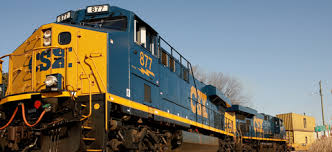
CSX posts record revenue as data center boom drives freight demand (Courtesy of the Jacksonville Business Journal) — The surge in data center construction is creating a new growth lane for CSX Corp.
As developers invest heavily in data centers and the power infrastructure needed to support them, the Jacksonville-based railroad is seeing greater demand to transport coal, frac sand, metals and heavy equipment tied to those projects.
That emerging business helped support a record quarter for CSX, which reported a 10% year-over-year increase in revenue to $3.94 billion during the second quarter of 2026. Total freight volume increased 6% to 1.68 million units.
The results prompted CSX to raise its full-year outlook, with the company now projecting revenue growth in the mid-to-high single digits, operating margin expansion of more than 350 basis points and free cash flow growth of more than 80%.
Capital spending remains projected at less than $2.4 billion.
Maryclare Kenney, CSX’s senior vice president and chief commercial officer, said investment in data centers and energy infrastructure is translating into demand across several freight categories.
That includes domestic coal used to generate electricity, frac sand and heavy equipment needed for construction and infrastructure development. Metals and minerals also performed well during the quarter as broader construction activity remained steady.
The data center-driven demand is part of a wider commercial opportunity for CSX as tighter trucking capacity and higher highway freight rates encourage more shippers to consider rail.
“Our opportunities to convert business to the railroads continue to grow as tighter truck supply and higher rates are highlighting the value proposition of brands on the merchandise side,” Kenney said. “This is most prominent in forest products, waste and metals. We also expect strength in conversions to support domestic intermodal volumes.”
Intermodal leads volume growth
Growth extended across CSX’s major business lines during the quarter.
Merchandise revenue increased 8%, intermodal revenue rose 26% and coal revenue climbed 9%.
Intermodal was the largest contributor to unit growth, with volume increasing 9%. CSX attributed the gain to domestic freight growth, new service offerings, truck-to-rail conversions and additional network capacity created by the Howard Street Tunnel.
Kevin Boone, CSX’s executive vice president and chief financial officer, characterized the quarter as one of record revenue for the Class I railroad.
“These results reflect continued partnerships across the business to improve safety and drive cost efficiency, while meeting increased demand from our customers,” Boone said. “Total revenue increased 10% benefitting from higher fuel surcharge combined with both volume growth and higher pricing across our merchandise, intermodal and coal markets.”
CSX posted operating income of $1.51 billion, up 17% from $1.28 billion during the same period last year.
Net earnings increased 21% to $1 billion, compared with $829 million in the second quarter of 2025. Diluted earnings per share rose 23%, from 44 cents to 54 cents.
The company’s operating margin improved by 240 basis points despite facing a 160-basis-point headwind from fuel prices.
CEO Steve Angel credited CSX’s railroaders with driving the improvement but said the company remains focused on building more consistent performance.
“We are proud of our accomplishments so far this year, but our objective is to build an organization that can consistently deliver strong performance over the last,” Angel said. “There are many areas across the business where we can improve performance, and network fluidity and service are among them.”
Safety improves as service faces pressure
CSX also recorded improvements in safety and productivity.
Its Federal Railroad Administration injury rate improved 19%, while its train accident rate improved 30%. Fuel efficiency improved year over year for the fourth consecutive quarter, and gross ton-miles per horsepower improved for the sixth quarter in a row.
Those gains came as CSX handled greater freight volume with a smaller workforce.
The railroad employed 1,343 fewer workers than it did during the second quarter of 2025. Average dwell time — the amount of time railcars remain at a terminal — increased 6%, from 10.4 hours to 11 hours.
Operating expenses rose 6% to about $2.4 billion, an increase of $138 million. Labor and fringe costs increased by $40 million, driven in part by inflation and higher expected incentive-compensation payments.
Angel said stronger merchandise demand added pressure to CSX’s service measurements, but he described the challenges as correctable rather than structural.
“While we were doing that, it added pressure, obviously, to our service metrics,” Angel said. “And I tell you, that’s our area of opportunity. We’re extremely focused on it. It’s not a structural service issue, and certainly not to minimize the importance of it. But we were very productive and just not as good as we needed to be. So the forward work is pretty straightforward for us.”