
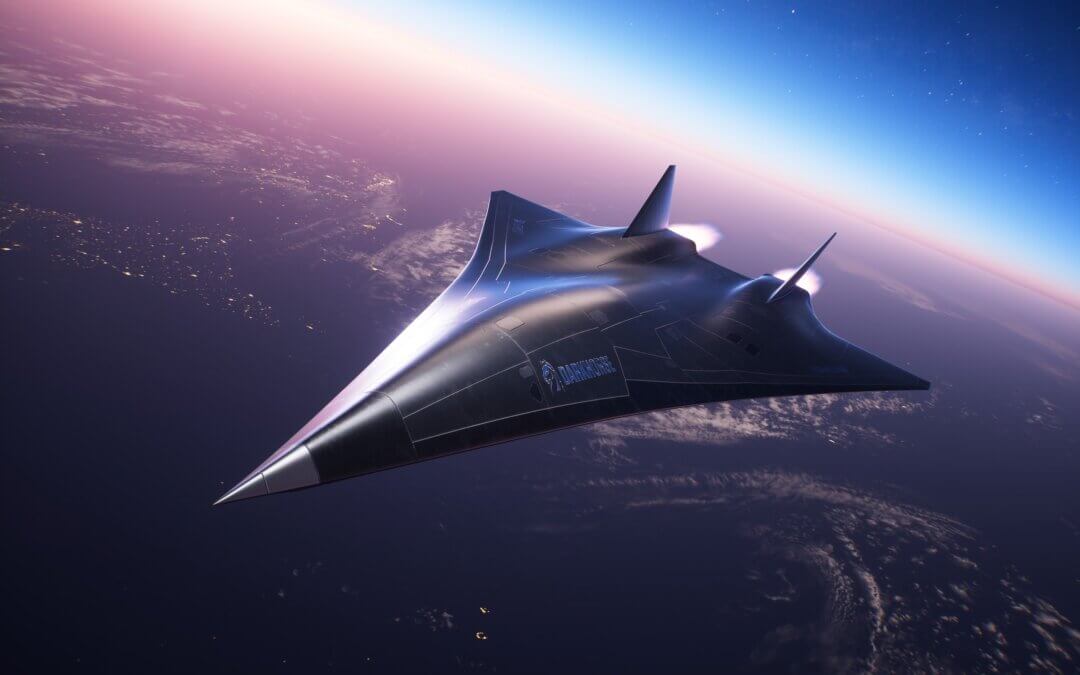
Hermeus poised to begin Mach-five testing at Jacksonville facility in coming days (Courtesy of the Jacksonville Business Journal) — Aiming to eventually transport passengers across oceans in the time it takes to drive from Jacksonville to Savannah, engineers with the company still face a long road ahead building a plane that can reach those speeds.
“There aren’t aircraft that we can fly at Mach Five and test our Mach Five engine on right now,” Miller said. “It’s also very expensive to do that, especially if you rely on that engine to power that aircraft, or else it falls out of the air. So we try to do a lot of that testing on the ground.”
Frequent on-the-ground testing is essential for developing the engines cheaply and quickly. For Hermeus, jets are far from the only thing leaders want moving at a rapid pace. Working with aircraft engine producer Pratt & Whitney, Hermeus uses the longtime aircraft manufacturer’s F15 engine as a base for developing its software, components and airframe for its planes.
Miller said part of the mission at Hermeus is to speed up the “iteration loop” of what it learns from engine testing, instead of moving the needle at a snail’s pace in a government-run facility.
“Unfortunately, one of the reasons why these technologies don’t already exist in the world, and especially in the United States, is that there’s a very limited availability of testing capabilities to test those high speed engines,” Miller said. “There’s a couple places with NASA and with the Air Force where you can test those, but it’s like multi-year wait times to get into those facilities, and everyone’s competing for it. If you can plan two years ahead when you want to run a test, you get your engine in, you test it, and then you take the learnings, and you have to get back in line for two more years for your next test, you’re not able to iterate very quickly.”
In turn, Hermeus focused on building its own capabilities to assess the best propulsion for its jets, Miller said, and Cecil Airport was uniquely suited for their needs with the perfect set of infrastructure in place for its HEAT (High Enthalpy Air-Breathing Test) facility.
With a couple of non-descript concrete blocks a few-dozen steps away from the Florida wilderness, but less than an hour’s drive from fast-growing population centers in Jacksonville, the facilities are just isolated enough from residential area to not cause a disturbance, but close enough to a city that is attractive for recruiting new employees.
Additionally, as passenger-travel on the high-speed jets is likely far in the future, flying the aircraft unmanned is appealing
But one of the most crucial components was having much of the necessary infrastructure already in place.
Company leaders pointed out how this provided significant cost-savings in 2024, preserving nearly $20-$30 million. On top of that, having a shell and foundation in place expedited Hermeus’ timeline for testing, Miller said.
“These were already here and had been abandoned by the government, and then some other people would use them in the past. So we were able to inherit a lot of this infrastructure and kind of start 60%, 70% of the way there toward building this capability,” Miller said. “So we’re able to take over this infrastructure, bring it back to life, upgrade it, and continue using it, even though it was developed and abandoned a long time ago.”
Twenty employees work full-time at the Jacksonville facility, but with operations spanning from Atlanta, Los Angeles and Washington, staff from all locations can fly in and test equipment, Miller said.
The targeted transformation of Jacksonville’s former naval base’s infrastructure into assets for aerospace companies such as Hermeus highlights the success in recent years of Cecil’s revitalization post base realignment and closure with $601 million of capital invested from 1999 to 2025.
A shift in focus for Jacksonville Aviation Authority has spurred the investment as leaders revamped their vision for the airport targeting more research and development institutions to take advantage of its spaceport infrastructure.
With the city, state, FAA and JAA working in tandem to pour more resources into Cecil and its Eastside development, even more growth is on the horizon, said Matt Bocchino, Director of Cecil Airport and Spaceport.