
How Modern Youth Apprenticeships Can Solve The U.S. Skills Gap (Courtesy of Forbes) — Are you scouting for high-potential employees, but hesitant to hire someone without a college degree? Consider this: Sergio Ermotti, the group CEO of UBS, the world’s largest private bank, began his career as a teenage apprentice at a small bank in his hometown of Lugano, Switzerland. He’s one of countless European business leaders who started their careers with on-the-job training instead of a bachelor’s degree.
In Switzerland — a global leader in education — 70% of students enter an apprenticeship program, while only 25% pursue a traditional university degree.
Contrast that to the United States, where roughly 40% of Americans have a bachelor’s degree or higher. Yet here, unlike in Switzerland, nondegree pathways like apprenticeships have been deprioritized. The result? Companies bypass a promising pool of employees, while millions of people eager to join the workforce find themselves unemployed or underemployed.
This is a huge missed opportunity, says Martin Ritter, CEO of Stadler Division North America in Salt Lake City.Stadler North America — whose parent company, Stadler Rail, is in Switzerland — has developed a youth apprenticeship program in Utah to produce the highly skilled talent it needs to manufacture high-quality rail vehicles. That program is modeled after the kind Ritter participated in as a teenager in Switzerland.
“Commercial apprenticeships in Switzerland produce a phenomenal workforce,” Ritter said. “If we want to become better in the United States, more competitive globally in terms of our productivity and quality output, it’s the only way.”
Increasingly, his fellow CEOs agree. In pursuit of new ways to recruit and develop an agile, high-performing workforce, more businesses are removing the college degree requirement from job applications. And some — including Stadler, professional services giant Accenture, and Pinnacol Assurance, Colorado’s leading workers’ compensation insurance provider — are going even further.
All three companies are getting outstanding results from work-and-learn programs they’ve created with help from local partners, including high schools, community colleges, and apprenticeship experts like CareerWise. According to Julie Wilmes, Pinnacol’s apprenticeship manager, “This isn’t just a moment. It’s a movement.”
Here’s a closer look at three apprenticeship programs that are helping drive that movement:
Pinnacol Assurance takes a proactive approach to talent management
Before exploring how to create what Pinnacol Assurance calls a “modern youth apprenticeship” program for your company, it helps to understand the why. Wilmes, who manages Pinnacol’s apprenticeship program — which has graduated 65 apprentices since 2017 and hired 18 of them — has an answer for that.
Too often, companies take a reactive approach to talent acquisition, she says, waiting until there are job vacancies before looking for people with the skills required. That might work OK during times of feast — for instance, when there’s a plethora of tech talent available — but not during stretches of famine.
Waiting until the last minute to source talent “is not a long-term, proactive solution,” Wilmes said. What makes Pinnacol unique, in the words of Tim Johnson, Pinnacol’s chief human resources officer, is the added value it offers as a “talent development organization.”
“That means we’re developing people to be their best at Pinnacol or wherever their journey takes them,” Wilmes said.
Every year, in partnership with CareerWise Colorado, Pinnacol recruits high school juniors and seniors into a three-year apprenticeship program designed to progressively build skills and experience in any of nine business and technology pathways.
Year 1 complements high school core curricula with classes in career-ready skills (such as time management and public speaking), along with an introduction to Pinnacol teams and career pathways. Participants also begin practical on-the-job training as Department of Labor-registered apprentices.
During Years 2 and 3, apprentices dive deeper into their personal pathways of interest. Those might be aligned with high-need areas in Pinnacol’s business, such as insurance services, or with the work done by corporate teams, such as marketing and human resources. Apprentices are also given scheduling flexibility and financial support to further their studies, if they want, at a postsecondary institution of their choice.
By the end of the three years, each apprentice has earned industry credentials, postsecondary education credits, and more than 2,000 hours of paid, work-based learning experience.
For Pinnacol and the communities it serves, the apprenticeship program — which former CEO Philip Kalin launched after visiting Switzerland with CareerWise founder and CEO Noel Ginsburg to view the Swiss model — helps alleviate the growingmismatch between the skills employers need and the ones job seekers possess. (A 2023 American Association of Colleges and Universities survey found only 44% of employers strongly agree college graduates are prepared to succeed in entry-level roles.)
To reduce the potential cost, complexity, and risk that deters some companies from offering apprenticeship programs, Wilmes says visionary leadership and executive buy-in are crucial.
In Pinnacol’s case, current CEO John O’Donnell told his leadership team, “The success of the apprenticeship program isn’t just the apprenticeship team’s job — it’s everybody’s job.” To help with that, Pinnacol chooses aspiring leaders to be apprentice supervisors and puts those mentors through a formal leadership training program while they’re supervising apprentices in real time.
Working with an intermediary like CareerWise has further improved Pinnacol’s ROI. Strategic sector partners can help recruit and train apprentices in industry-specific skills and track outcomes. The regional business community benefits, too: Any apprentices who don’t pursue a career at Pinnacol join a pool of excellently trained talent available to other employers in Colorado’s workforce ecosystem. Pinnacol apprentices have been hired at organizations including Best Buy, CareerWise Colorado, and Meta.
Gil Portillo, 20, is a recent apprenticeship graduate who became a full-time junior help desk technician at Pinnacol. Hiring Portillo — a bright, motivated employee who grew up in a low-income household and couldn’t afford college — was a move his boss Steve Boyd believes helps Pinnacol’s succession planning.
“Our help desk has a lot of folks reaching their age of retirement,” he said. “This program has been a wonderful pipeline to transfer some of that legacy knowledge to the apprentices.”
“During my first year, I couldn’t drive, so I would bike an hour to work every day,” Portillo recalled. “This apprenticeship program is such a great opportunity, I didn’t want to let it slip from my grasp. So, I was dedicated.”
Boyd likes to share a story that shows how investing in motivated young people like Portillo — who is now working on a bachelor’s in cybersecurity at Colorado State University — pays off in loyalty and hard work.
Boyd had scheduled a meeting with Portillo and Bren Lane, the help desk lead. Portillo joined remotely, and his video image was bouncing all over the place. “Gil, are you on a roller coaster?” Boyd asked.
Portillo explained he was in the back seat of a bus, en route to a school track meet, but knew he needed to join the meeting. “We could have rescheduled,” Boyd told him.
“No, I’ve got time,” Portillo replied. “Let’s do this.”
After the meeting, Boyd thought, “That’s the type of person that this organization needs.
Someone who is going to give it their all, who is invested in their future, and has a strong work ethic.”
Pinnacol has seen these qualities in Portillo firsthand. “We can teach you technology, but we can’t teach you to be a good, caring person,” Boyd said. “I’m so proud of what Gil has accomplished. He is a perfect example of the benefits of building talent from within.”
Stadler prepares apprentices for a career, not a job. Here’s the difference.
When Martin Ritter moved to Utah from Switzerland to start Stadler’s U.S. division in early 2016, he faced a challenge: he had to build a workforce of skilled technicians from nothing, with no way of knowing which kinds of credentials signified a true seal of quality.
“We needed electricians and mechanics,” he said. “So, we were Googling certificates and asking, ‘Is this relevant? Is it even real?’”
Stadler ended up bringing people from Switzerland to train the local workforce. “Training became an important part of the company, especially for the first two years,” he said. “That’s when I asked, ‘Why is there no apprenticeship program?’”
Ritter’s first hire was a young worker with a college degree — and a lot of student debt — who had to be taught from scratch. “The education system cannot be efficient if you’re producing, at a high price, workforce talents that are not tailored for the market,” he said.
By 2019, Stadler US — in collaboration with local high schools and Salt Lake Community College, among other partners — had created a three-year youth apprenticeship program with a general education component. It had also recruited its first class of apprentices.
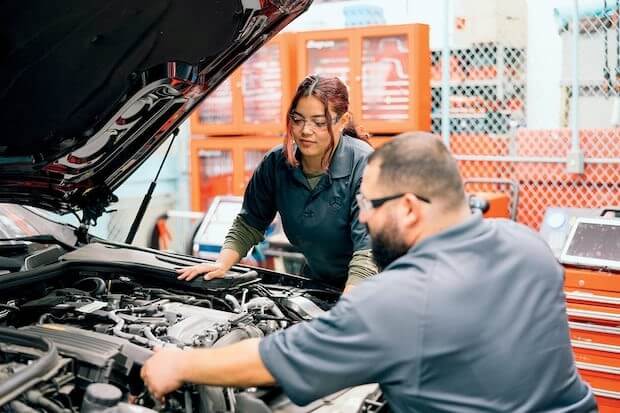
In Year 1, participating high school seniors split their time between classes at school and paid on-the-job training at Stadler, pursuing either an electrical or mechanical technician track. In Years 2 and 3, apprentices attend community college classes and work more hours, with higher wages and more advanced training at Stadler.
The combination of theoretical learning and productive work motivates students, because they get to apply what they’ve learned. Ritter says the company starts to see a return on investment in its apprentices by Year 3.
What makes Stadler’s apprenticeship program particularly effective? It provides a broad baseline curriculum that prepares students for many technical career paths — it’s not just narrowly tailored to technicians who build trains.
“It’s not a custom-fit training program,” Ritter said. “Whether you wire a boat, a truck, a plane, or a train shouldn’t matter.”
Instead, Stadler’s apprentices end up with an associate degree in advanced manufacturing that will increase their worth in the labor market, even if they change companies or industries.
“That’s the difference between a training program and an education program,” Ritter said. “I think it’s a very, very important distinction.”
Of course, Stadler would prefer graduating apprentices join the company as full-time technicians. The company typically recruits 12 to 15 new apprentices each year and loses a few over the three-year program.
“That’s not good enough for us, but the school district is pretty happy with it,” Ritter said. Apprenticeships often ignite a fire in disengaged students who aren’t on a four-year college track. “We have to get access to those talents, the 65%,” Ritter said. “Those are the raw diamonds.”
Of those who completed the program, most apprentices have stayed with the company so far, with excellent results. Stadler US’ commissioning team lead (the advanced technicians who work on the train while it’s running at full power) recently told Ritter, “It’s hard to find skilled people. The apprenticeship program is my best source of talent.”
Based on his positive experiences here and abroad, Ritter has become an enthusiastic champion of work-and-learn programs in the United States and hopes they’ll become more commonplace in the private and public sectors. Recently, three governors at a round table asked what they could do to support these initiatives.
“Be an example,” he told them. “If the governor says, ‘I need 50 apprentices across the state in two years,’ then everyone will work towards that.”
“There will always be plenty of people telling you why this won’t work,” Ritter added. “It’s a cultural change, but it’s an investment in society, too. I think one must have a little bit of courage and just do it.”
Accenture hires apprentices with the ability to learn
When choosing an employee to oversee software implementation at a client’s combined cycle power plant in Texas, Accenture didn’t select someone with a degree in electrical engineering. Instead, the company gave the job to Josie Wheeler, a nontraditional hire who’d joined the company in 2019 as an apprentice.
Just three years earlier, Accenture had launched a formal 12-month apprenticeship program in collaboration with the City Colleges of Chicago. The goal was to diversify Accenture’s talent pipeline and address the growing skills gap in the technology sector. The program — which has expanded to 40 cities nationwide and makes up 20% of Accenture’s entry-level hiring — provides education and on-the-job training to talented individuals who are often overlooked in standard recruiting channels.
Wheeler was one such candidate. As a student who’d struggled with conventional schooling, after high school she skipped college in favor of hands-on experience in several professions — including work as a chef, bartender, and fashion photographer.
One day while driving through downtown Detroit, Wheeler saw a sign for a 12-week coding boot camp. “I decided technology was way more my speed than what I’d been doing,” she said, so she enrolled. A few months after completing the software coding program, Wheeler saw a posting about Accenture’s apprenticeship program. She applied and was accepted.
After 12 months of hands-on training, Wheeler was assigned to a robotic process automation project at a utility company. (RPA creates software to automate tasks like data entry and form filling, freeing up employees for more complex, creative work.) That led to a series of jobs with power-generation clients — including nuclear — that prepared her for her current leadership responsibilities.
Despite entering a challenging new industry in her mid-twenties, Wheeler caught on quickly by tapping into the skills she’d gained over the years, like customer service and good communication.
“I have years of work experience that gave me so much knowledge I can adapt that you don’t get when you go to college,” she said. “Relationship-building is just second nature to me.”
That adaptability and ability to learn quickly is exactly what Accenture looks for in the apprentices it hires. “If you think about the competitiveness of the world ahead of us, agility to learn is the most important skill anybody can have,” said Pallavi Verma, executive sponsor of Accenture’s apprenticeship program.
Credit for conceiving and championing the new talent pipeline goes to Accenture CEO Julie Sweet, in collaboration with Greg Case, CEO of global insurance company Aon. Both companies are members of the National Apprentice Network, which aims to create 10,000 apprenticeships nationwide by 2030.
“We recognized we wanted to get the best talent on the planet and wouldn’t succeed if we weren’t searching for talent everywhere,” Verma said. “We were focused on four-year colleges or MBA programs. To get the best of the best, we needed to widen our aperture.”
Many companies are deterred from launching an in-house apprenticeship program due to the perceived cost and complexity of training. But Carrie Diewock, managing director at Accenture, says it’s not as daunting as it sounds.
Much of the education is informal, with skilled employees teaching the apprentices, who are truly grateful for the opportunity to work and learn. The company also repackages the existing materials it uses to train entry-level employees.
“There are times where we might put an apprentice through a specialized course, but for the most part, we put them with other Accenture employees on a team, and that team teaches the apprentice,” Diewock said. “It’s quite simple to do. The apprentices have the passion and desire to make this work, so they get hyper-focused on learning and making sure they’re doing a good job. That, coupled with the skills employees already have, means you don’t need to put together a lot of organized pre-materials and create an internal college to teach.”
Just eight years ago, Tiffany Spraggins was living in affordable housing in Chicago, driving for Uber, and raising three young kids on her own. Today, she works in quality engineering at Accenture, testing generative AI tools to help improve sales.
How did Spraggins transform her life so dramatically? She joined Accenture in 2018 as an apprentice. After working at a series of jobs after high school — including security, cleaning, and clerical positions — she “worked backwards” to re-engineer her future by deciding what kind of salary she wanted, what types of jobs paid that well, and the shortest educational path to get there.
She decided on a network systems and technology degree from the City College of Chicago, which she attended full-time thanks to her flexible Uber hours. At a networking event, Spraggins met Melissa Summers, a managing director at Accenture, who invited her to join Accenture’s table at the International Women’s Day celebration.
Several months later, Spraggins interviewed with a panel from Accenture, who’d come to her college to recruit apprentices. “There’s a lot of untapped talent in the city colleges,” she said. That’s a view Accenture shares. Spraggins applied and was hired.
Since joining Accenture, Spraggins (who is pursuing a certification in her field of quality engineering) has enjoyed networking opportunities she’d never imagined, including meeting former Chicago Mayor Lori Lightfoot and Illinois Gov. JB Pritzker.
“I appreciate Accenture giving me a start, but it’s so much more than just giving me a chance,” she said. “It’s also the continuous opportunities to promote the program that have been life-changing for me. My lifestyle is so different than it was before. And my children have a pathway to come into this field if they want. Accenture has become a part of my family, not just a job.”
That kind of lasting employee loyalty is one of the greatest rewards companies get from their apprentices. For Spraggins’ colleague, Josie Wheeler — who still sometimes pinches herself at going from bartending to meetings with nuclear power plant operators — Accenture is a lifetime commitment.
“I know a lot of my generation likes to career hop,” Wheeler said. “But I fell in love with Accenture. The position I’m in is really exciting. I would never want to give that up.”
Many of the mentors she had when she joined are mentors to this day, and new ones have become a huge part of her life. “I always feel support,” Wheeler said. “I’ll work here as long as they let me.”