
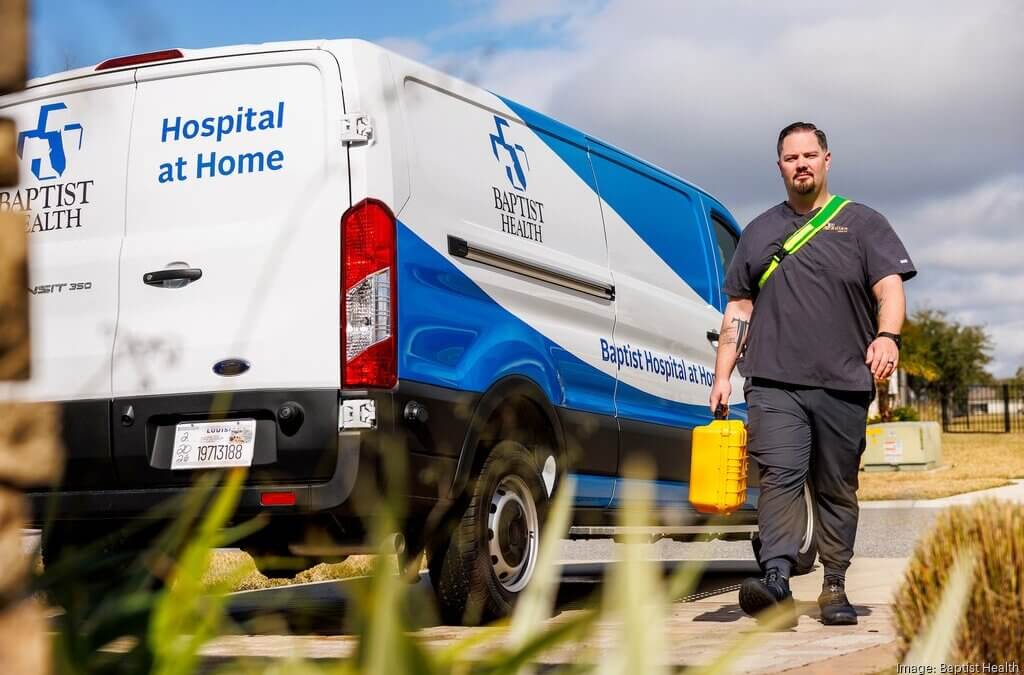
How one local system turned to AI to scale its health-at-home program (Courtesy of the Jacksonville Business Journal) — When Baptist Health announced a care expansion in February, it didn’t literally grow the healthcare system’s physical footprint. Instead, it began a program called Hospital at Home: round-the-clock service to bring hospital-level care to patients’ homes.
The endeavor to determine which patients are the best fit for the at-home program — offered to clinically stable adult patients with acute care needs — begins by nurses sorting through medical records, often hundreds of pages.
To alleviate some of that tedious legwork, Baptist has partnered with North Carolina-based Vega Health and implemented artificial intelligence into the process.
“Innovation at Baptist Health has always been in service of one goal: better care for the patients and communities we serve,” said Dr. Irene Louh, vice president of data intelligence and decision science at Baptist. “We hold AI to a high bar: it has to be safe, it has to be clinically meaningful, and it has to perform for our patients, not just on a benchmark dataset from somewhere else.”
Together, Vega helps physicians quickly identify which patients meet the clinical criteria for home-based care.
It all operates within Baptist’s existing framework, explained Vega CEO Mark Sendak, who co-founded the company in October 2025.
Vega launched with $4 million in seed funding from Bessemer Venture Partners, a California-based venture capital firm, and spun out from Duke Health.
With Baptist, Vega’s system acts as a screening and information gathering tool, reducing the time spent searching through charts and compiling data.
“Vega Health started with our criteria, our patients, and our clinical context and the result is a solution that feels like it was built for us, because it was,” said Dr. Alison Bartfield, medical director of Baptist Hospital at Home. “That’s the kind of collaboration that makes AI actually useful at the bedside.”
The collaboration remains in an early implementation stage, said Sendak, with plans to scale the technology into other areas of the hospital.
He said Vega aims to be that place where healthcare organizations can scale AI models without having to start completely from scratch.
“There’s not a two-sided marketplace, there’s no app store for AI in healthcare that is broadly accessible to innovators,” he explained.
At the moment, Baptist and Vega are focused on refining the tool for its frontline users. When the hospital at home program initially began, it was offered at Baptist’s flagship Southbank campus, with plans to expand to Baptist Medical Center South and other adult hospitals within the system. Vega intends to help that trajectory.
The success of its efforts will likely be measured how effectively the AI tool meshes with clinician’s work.
It’s something that was sought early on in the collaboration, long before hitting go.
“We saw this highly manual, highly fragmented process where different people were spending a lot of time going through the medical record looking for information,” said Sendak. “We just started working with them on, ‘Give us the lists of information that you need, and then we will figure out how to automatically curate, synthesize, present that information.’”
Photo courtesy of Baptist Health