
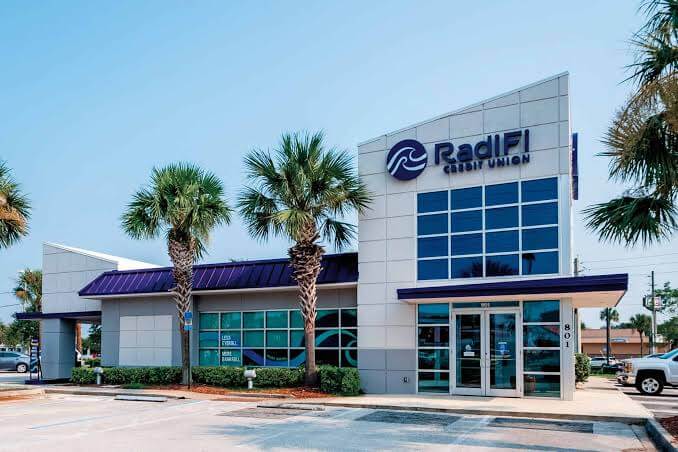
RadiFi Credit Union’s new CFO charts growth strategy focused on education over mergers (Courtesy of the Jacksonville Business Journal) — National banks and community institutions crowd Northeast Florida’s financial ecosystem. Though not the region’s biggest, RadiFi Credit Union is betting its next phase of growth will arrive by blending education and a community-first ethos to stand out against competition.
That’s according to Daniela Neacsu, the neighborhood credit union’s newly installed chief financial officer. She described a middle market advantage — large enough to invest in the latest analytics and tools but small enough to be nimble and move quickly.
It’s been under two months since Neacsu moved to the First Coast, joining after more than seven years in Allen, Texas with Community American Credit Union.
Her stance on what growth means is rooted in healthy skepticism. Specifically, skepticism about whether mergers and consolidations bring true expansions for financial institutions — a trend sweeping the industry today, she said.
Before migrating to the Sunshine State, Neacsu herself experienced a merger that rebranded UNIFY Financial Credit Union to CommunityAmerica Credit Union. She framed such strategic decisions as a double-edged sword: on one side, useful to expand impact but, on the other, risks pulling institutions away from their core mission.
“I see my own development of RadiFi, especially knowing this growth stage [is] very deeply connected, one fuels the other,” she said. “I believe the moment we stop growing is the moment we stop becoming relevant.”
Relevance is a core part of the credit union’s strategy locally.
RadiFi is among the region’s largest credit unions with $710 million in assets with over 41,500 members. Last year it was the runner-up fastest-growing institution on the First Coast, with 5.91% deposit growth year-over-year, according to the latest National Credit Union Administration data. It ranked behind Community First Credit Union which saw 10.26% growth.
When ranked by total deposits, it lands at No. 4 with $555.81 million — about $450 million behind the third seed, per National Credit Union Administration data.
Neacsu’s view reflects a certain kind of cautious approach being employed by the local credit union in this present moment. Leadership, she said, believes remaining independent allows it to move quicker, invest more directly in member relations and avoid some of the operational drag common when two large organizations merge.
“The big institutions, they will not spend that much time on educating people at their level,” she said. “We have that time, we can afford that. We can afford the time and the investment to make in our community.”
The CFO’s read on Jacksonville, though still early, underscores how distinct the local market is from her previous role in Texas. Both regions see rapid population growth and credit union competition, but Neacsu described Northeast Florida as distinctly more competitive.
RadiFi’s in-between size, not the largest but still far from the smallest, gives it the agility to beat out opponents. Ultimately, the credit union’s growth strategy plays straight into how it competes in Jacksonville.
Instead of chasing scale at all costs through acquisitions, leadership is focused on relevance over many years, particularly as the area continues to grow. In the eyes of Neacsu, that happens by retaining organizational identity.
“All these mergers that happen in the industry, it will be a risk for the credit union industry to move away from their main reason of existence,” she said. “We don’t want to be banks. We want to keep our main reason for existence: being close to our community and serve them.”
Photo courtesy of RadiFi Credit Union