
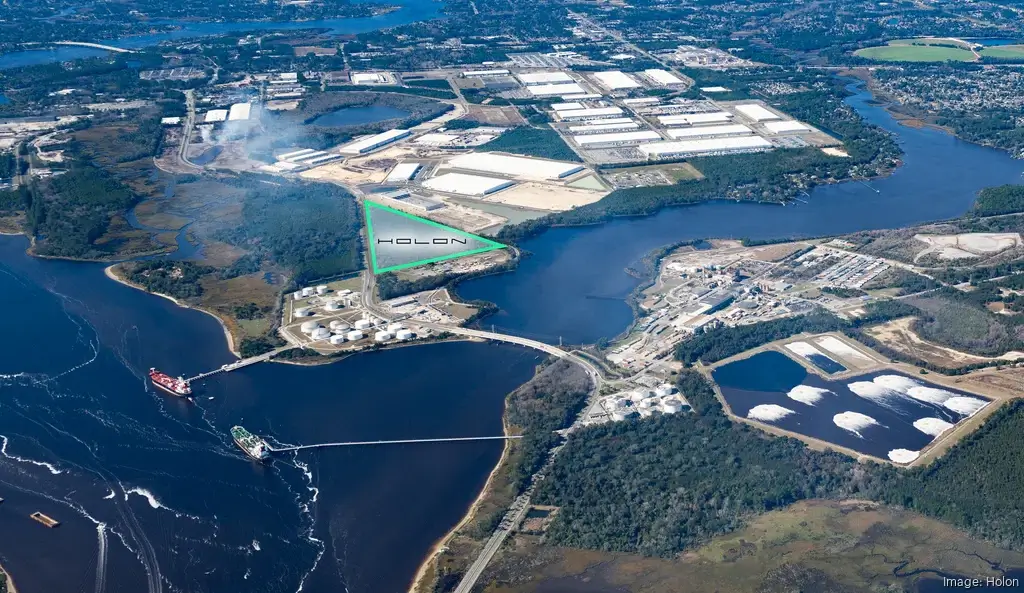
Holon shifts Jacksonville autonomous vehicle factory plans to phased approach (Courtesy of the Jacksonville Business Journal) — Holon’s Jacksonville project is still aimed at making Northeast Florida a U.S. hub for autonomous transit manufacturing. But the company now says the road to that larger factory will likely begin with a smaller first step.
The German autonomous vehicle company and parent organization Benteler Mobility are outlining a phased strategy for Jacksonville, starting with vehicle testing, commissioning and potentially limited production before moving into the large-scale manufacturing operation announced last year.
For Jacksonville, that means one of the city’s most high-profile advanced manufacturing wins remains active, according to company executives, but its timeline is being shaped by the realities of a still-emerging autonomous vehicle market.
“We are still fully committed to Jacksonville,” Tobias Liebelt, CEO of Benteler Mobility, recently told the Business Journal.
The comments offer the clearest explanation yet of how Holon is thinking about its Jacksonville project after the company signed a term sheet in October for what was announced as its first U.S. production facility.
At the time, the company said it planned to build the Holon Urban, an autonomous, fully electric shuttle designed for public transit, at a roughly 580,000-square-foot facility at Eastport Industrial Park in North Jacksonville. The project was projected to represent more than $100 million in capital investment, create at least 150 permanent jobs and support Jacksonville Transportation Authority’s Ultimate Urban Circulator program.
A University of North Florida study estimated the facility could generate more than $200 million in local economic impact during construction and $87 million in annual economic output beginning in 2028.
The October announcement included an April 2026 groundbreaking target, with commissioning expected in late 2027. Although the company has not broken ground, executives remain optimistic about the future.
A phased path to production
In an interview with the Business Journal, Liebelt and Gregory Crandell, general manager of Holon US, said the company’s next steps in Jacksonville are likely to come in phases.
The first focus is a pilot.
Liebelt said Holon is working to bring four vehicles to Jacksonville by the end of this year, in coordination with JTA. The company also expects to open a Jacksonville facility where vehicles can be commissioned and tested on private property before moving onto public roads.
From there, Holon could move into what Liebelt called “small serial production” before building out a larger manufacturing operation.
That smaller production model would not be a prototype shop, he said. Instead, Liebelt described it as production of a homologated, regulatory-aligned vehicle that could support early market demand before the company scales up.
The approach could allow Holon to produce somewhere between 100 and 1,000 vehicles before it moves into a full original equipment manufacturer-scale facility, he said.
The larger factory remains part of the plan, Liebelt said, but the company is trying to match investment to a still-developing market.
That is where the timing becomes more complicated.
Holon is not positioning itself as the autonomous driving software company. Liebelt said Benteler’s strength is manufacturing, supply chains, vehicle platforms and industrial execution. The company is one of the largest automotive suppliers in the world, with more than 100 factories and roughly 25,000 employees globally.
But the autonomous shuttle business depends on a broader ecosystem: vehicle manufacturing, autonomous technology providers, transit agencies, regulators and operators.
Liebelt said that ecosystem has not developed as quickly as many in the industry expected several years ago.
“We can’t make a quick decision by saying, ‘OK, let’s open the factory, let’s hire whatever, 500 people, and then let’s see if the tech guys are keeping their promises,’” Liebelt said. “This gamble is too hard for us.”
The issue, Liebelt said, is less about a single piece of hardware or software and more about the full safety case for operating purpose-built autonomous transit vehicles on public roads.
That includes how vehicles respond to edge cases, how responsibility is divided among manufacturers, technology providers and transit operators, and how regulators become comfortable with vehicles that do not have a traditional driver.
Liebelt said the industry has also learned from high-profile setbacks in the autonomous vehicle sector, including Cruise, the General Motors-backed company that halted operations after a 2023 pedestrian incident in San Francisco and was later folded into GM.
Safety, reputation and public trust are now inseparable from the production timeline, he said.
“I do not want Benteler to become the next Cruise,” Liebelt said.
That caution, he said, should not be read as a lack of confidence in the technology or Jacksonville.
Liebelt said autonomous transit continues to advance, particularly as artificial intelligence accelerates software development and global competitors push the market. But he said the timing of that development is difficult to predict.
The company’s strategy, he said, is to build toward production while avoiding a mismatch between factory capacity and near-term demand.
Crandell said Holon has already taken regulatory steps in the U.S.
The company has been listed as a Transit Vehicle Manufacturer, a federal designation for companies whose primary business is building vehicles for public mass transportation. Crandell also said Holon has received approval from the National Highway Traffic Safety Administration to bring vehicles into the U.S. for the pilot program.
The next steps involve working with JTA on how and when the vehicles come to Jacksonville, where they are housed and what needs to happen before they operate publicly.
“It’s not just to set them on the road and go,” Crandell said.
Crandell also said Holon remains in compliance with both the City of Jacksonville and the State of Florida on its incentive agreements.
He said the company has proactively notified both that it may need more time as production is aligned with demand and technology readiness. Crandell said both the city and state have responded that Holon remains in compliance.
Liebelt also emphasized that Holon has not received public incentive dollars.
That point is important because the Jacksonville project includes city and state support tied to investment and job creation. The city previously approved a 10-year, 75% Recapture Enhanced Value Grant valued at up to $7.5 million, along with a training grant of up to $200,000. State incentives were also tied to investment and job-creation benchmarks.
Holon executives said the company continues to view Jacksonville as the right U.S. base, and not only because of incentives.
Liebelt said Jacksonville’s geography is part of the appeal. The city’s size and suburban growth create the kind of mobility challenge where autonomous transit could eventually extend service beyond dense urban corridors.
In many cities, Liebelt said, public transportation works reasonably well in the urban core but becomes less efficient in suburban and lower-density areas. That is where he sees the strongest opportunity for autonomous shuttle service.
Jacksonville’s size also makes it different from markets that are more attractive to private ride-hailing or robotaxi companies, he said. In a spread-out city, trips from the urban core to suburban areas may not produce the predictable return trips that ride-hailing companies look for.
That creates room for a public transit application, he said.
Crandell said Jacksonville’s broader development momentum also played a role, citing downtown investment, the Museum of Science & History project, the Jaguars’ stadium renovation and new residential growth.
But both executives said JTA was central to the decision.
Crandell said JTA’s early work with autonomous vehicles made the agency a strong partner for a company trying to enter the U.S. transit market. Holon’s Jacksonville office is also located below JTA’s headquarters, which Crandell said allows for close coordination.
“JTA and Nat Ford have been among the most innovative public transit leaders in using autonomous vehicles,” Crandell said.
Liebelt said Jacksonville offered another advantage: It is visible enough to matter, but not as risky as launching in a much larger and more complex transportation market.
Starting in New York City or downtown Miami would create a different level of operating risk and public scrutiny, he said. Jacksonville gives Holon and JTA a place to test, learn and refine the model in a major U.S. city without some of the complications of a larger global gateway market.
The region is also easier to recruit to than some traditional industrial markets, Liebelt said, particularly for technical workers and employees coming from Europe. He cited North Florida’s climate, quality of life and labor pool, including military and aerospace-related talent.
Building demand before building scale
The business case for Holon is tied to a broader question: whether public transit can become attractive enough to pull some riders out of personal vehicles.
Liebelt said that will require more than simply offering another bus-like service. Riders will need a reason to change habits, whether that is convenience, travel time, price, accessibility or experience.
The Holon Urban was designed with that in mind. The company worked with Pininfarina, the Italian design firm known for its automotive work, to give the vehicle a different look and feel from a traditional bus.
Depending on the market, Liebelt said, the vehicle could be configured for a more premium service or for a more standard public transit use case.
The flexibility is part of the strategy, he said, because different riders will need different reasons to try autonomous transit.
In Jacksonville, the immediate test will be more practical.
Holon needs to get vehicles into the market, work through commissioning and regulatory steps, support JTA’s autonomous transit ambitions and demonstrate enough demand to justify larger production.
That is a different story than a simple factory groundbreaking. It is also a more complicated one.
The company is asking Jacksonville to view the project as part of a developing technology market rather than a conventional manufacturing announcement with a predictable construction schedule.
Liebelt said Benteler has opened factories around the world and understands the obligation that comes with hiring workers and investing in a community. The company does not want to make those commitments until it is confident the market can support them, he said.
At the same time, he said the company understands the expectations created by last year’s announcement.
“We understand that we have created ambitions and expectations,” Liebelt said.
The next visible step is expected to be the pilot, followed by the commissioning and testing footprint in Jacksonville. If those pieces come together, Holon would then be positioned to begin limited production before scaling into a larger facility.
For Jacksonville business leaders, the updated strategy leaves the city with a more nuanced picture.
Liebelt said success over the next five to 10 years would be Jacksonville becoming a model for how autonomous transit can be integrated into a U.S. city.
For now, that transformation appears likely to start smaller than the factory announcement suggested. But Holon’s argument is that starting smaller may be what allows the project to grow.
Rendering courtesy of Holon