
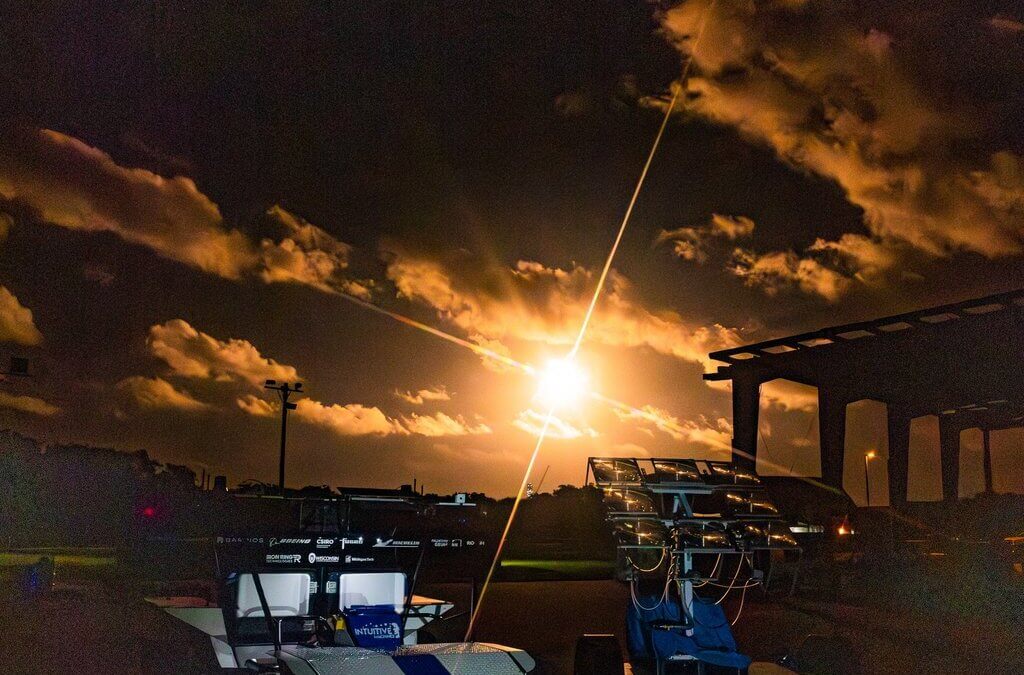
With completed $65M Series A raise, Star Catcher prepares its next giant leap (Courtesy of the Jacksonville Business Journal) — Star Catcher has completed an oversubscribed Series A funding round, locking in $65 million — a hefty bet from investors that the Jacksonville-based startup can turn its ‘power grid in space’ technology into a viable commercial service.
Roughly a year after a successful ground demonstration at EverBank Stadium and another six months later in Cape Canaveral, this raise is designed to fund Star Catcher’s next hurdle: building flight heritage, including its first satellite launch, and scaling up.
The new investment was led by California-based firms B Capital and Shield Capital alongside New York-based Cerberus Ventures, the venture arm of Cerberus Capital Management. Its completion brings Star Catcher’s total capital raised to $88 million.
“It is my ambition that Star Catcher is a transformational entity for the space sector,” said Co-Founder and CEO Andrew Rush in a conversation with the Business Journal. “I deeply believe that eliminating the power bottlenecks in space operations is as transformational for space as reusable launch vehicles, like as the Falcon 9 from SpaceX.”
Homegrown space innovation
Founded under two years ago, the Jacksonville company is pioneering what it called “space-to-space power beaming” which, in essence, would be the technological infrastructure of an energy grid in orbit.
The basic principle of how it all works is simple: Every satellite in space uses solar rays to generate power with more power generated based on their intensity. But power is a finite amount in space right now, Rush said. With Star Catcher’s technology, the goal is to collect that solar energy, intensify it and send it to client spacecraft and satellites.
“The philosophy that we take is a ‘crawl, walk, run’ philosophy, both from a product development, customer development and technology development perspective,” Rush said. “Where we’re going from now, is applying that same philosophy to our development, but doing it in space.”
The company’s March 2025 test created a tailwind for Star Catcher, driving growth and talent to the First Coast. Its team has grown to 35 people, Rush said, working in a 15,000-square-foot office close to the St. Johns Town Center.
That EverBank test was also the technological foundation for its November demonstration on the Space Coast. There, it set a world record for wireless optical power transmission, surpassing a benchmark set by the U.S. Defense Advanced Research Projects Agency earlier that year.
Star Catcher beams power to Intuitive Machines’ Lunar Terrain Vehicle (LTV), demonstrating how space power beaming could enable continuous operations on the lunar surface.
With $65 million now secured, Star Catcher is shifting decisively into its next phase: proving its technology works in the one place that matters.
“The coin of the realm for space companies as they progress from opportunity to product market fit to scaled product for service is getting flight heritage and then scaling that up,” explained Rush. “It’s really the eye of the needle for us.”
Later this year, Star Catcher aims to launch the first-ever space-based optical power beaming demonstration — a foundational step forward, if successful. It’ll be the first in a series of flight missions of this caliber.
Success in-orbit, aside from the technological achievement, translates to accelerated commercial traction, developing prospective customers’ confidence that Star Catcher’s system can be deployed reliably at scale.
To-date, Star Catcher’s customer base spans commercial space operators and U.S. government stakeholders. It’s signed seven power purchase agreements, secured multiple government contracts and is managing a qualified commercial pipeline representing more than $3 billion in projected annual recurring revenue, according to a spokesperson.
Aside from capital itself, the Series A round adds to Star Catchers’ deep bench of advisory talent. Cerberus’ Retired General John Raymond, the U.S. Space Force’s first chief of space operations, will join Star Catchers’ board, along with B Capital General Partner and Global Head of Energy Jeff Johnson and SHIELD Principal David Rothzeid.
“Every major application driving the space economy — connectivity, computing, security, sensing — is power-limited today,” said Rush. “Star Catcher is lifting that ceiling — making it possible to build in orbit at the scale the next century of life on Earth will demand.”
Photo courtesy of Starcatcher